Chalet drainage in the Giffre Valley: who to contact? Mains or septic tank? Steps and costs
You're building, renovating or have just bought a chalet in the Giffre Valley, and someone has told you “you'll need to sort out the drainage”. The trouble is, no one has explained where to start.
Should you call a plumber? The town hall? A groundworker? And is your house actually connected to the mains sewer or fitted with a septic tank?
The good news is that it's not that complicated once you understand the logic. The first question is never “which tradesperson should I call?”, it's “am I on mains drainage or off-mains?”. Everything else follows: the procedures, the contacts, the work, the budget.
This article provides you with the complete, step-by-step route, with a focus on the local specificities of the Haut-Giffre and Haute-Savoie.

House drainage: what exactly are we talking about?
When we talk about drainage (assainissement), we mean treating your home's wastewater. That includes blackwater (from toilets) and greywater (kitchen, bathroom, washing machine). The aim is simple: this water must be treated before returning to the natural environment, so it doesn't pollute soil and rivers. So far, common sense. Where it gets complicated is that there are two very different systems.
Mains drainage
Your house is connected to the public sewer – the mains drainage. Your wastewater flows through underground pipes to a treatment plant run by the local authority. You pay a charge on your water bill, and in return the local authority handles the treatment. This is the case for most houses in village centres.
Off-mains drainage
Your house isn’t connected to the public sewer. It has its own independent installation: an all-waters septic tank (the old term “fosse septique” is outdated and only covers part of the old setup), a micro treatment plant, or a treatment unit with a soakaway or sand filter. This is common in rural areas and hamlets, and particularly so in the mountains.
Why is that the first thing to check
Because everything depends on it. The procedures aren't the same. The contacts aren't the same. The tradespeople aren't the same. And especially, the budget isn't the same. If you don't know which situation applies to you, everything you do next will be shaky. So before calling anyone, check.
Good to know — Haut-Giffre: In the Montagnes du Giffre area, the CCG (Communauté de Communes des Montagnes du Giffre) has managed mains drainage since 1 January 2026, while the SPANC (the public service for off-mains drainage) already covers off-mains systems across the whole intercommunal area.
How can I tell whether my house is on mains drainage or not?
Check the drainage zoning
Each municipality has a drainage zoning map showing which plots are on mains drainage and which are not. You can consult it at the town hall or the communauté de communes. In the Haut-Giffre, the CCG can advise you directly. You'll also find it in the appendices of your municipality's PLU (local plan).
It's a technical document, but the question it settles is simple: is your land in a mains drainage area or not?
Look at the property's actual situation
If you’re buying an existing house, check what’s already in place. Is there an inspection chamber in the garden? Is there a septic tank buried somewhere? Is there a visible connection to the mains sewer system in the street? The sewerage inspection report (which is compulsory when selling a property) will provide you with this information. If the house is old and no one has ever checked it, now is the time to do so – it’s better to discover a problem now than in three years’ time, when sewage starts backing up into the garden.
In the case of a new build
A plot can be buildable, serviced, perfectly square and flat – none of that tells you anything about drainage. Land in an off-mains area will need a soil survey and an individual system, which radically changes the budget. Many future owners find this out too late.
Tip: Before calling a tradesperson, always check what type of drainage system applies to your plot. A quick phone call to the town hall or the CCG is all it takes.
Who does what in a sewerage project?
This is probably the question that causes the most confusion. There are lots of people to contact, and it’s not always clear who to call first.
The local authority and the public service
The communauté de communes (or the town hall, depending on local arrangements) sets the rules: zoning, service regulations and connection application forms. It oversees the system; it doesn't dig the trenches on your property.
SPANC
The SPANC only deals with off-mains drainage. It's the service that approves your individual system, carries out the design check before work, and comes back to check compliance afterwards. In the CCG area, the SPANC is the dedicated off-mains drainage service. Its role is as much advice as inspection – don't hesitate to call them early on; that's what they're there for.
The mains sewer operator
For connection to the mains drainage system, the relevant contact depends on the local council. In the Haut-Giffre area, Veolia Eau remains the network operator in many localities (Samoëns, Morillon, Verchaix), whilst Mieussy is managed by the CCG. The operator will provide you with the technical specifications for the connection and will carry out the connection inspection.
The tradespeople
And finally, those who carry out the work. Depending on the project, you will need a groundworker or a road and utility works company to dig, a plumber for the connections, a specialist installer for individual wastewater treatment to fit a micro-station or a septic tank, or a emptying company to decommission an old installation.
The key point to remember is simple: Public services provide direction and oversight; tradespeople carry out work on private property.
If I'm building a new house: what are the steps?
Case 1: land in a mains drainage area
The process is relatively straightforward. You first check that connection to the network is technically feasible (proximity of the network, altitude, drainage slope). You submit an application to the local authority or the operator, who will send you the technical specifications. The tradesperson then carries out the connection work on your land (trenching, pipes, inspection chambers, possible separation of foul water and rainwater in the case of a separate system). Finally, a connection inspection validates the entire process.
Case 2: land in an off-mains drainage area
Here, the process is longer and more expensive. First, a soil study (also called a site investigation) must be carried out, which will determine what type of installation is suitable for your land – soil type, permeability, slope, presence of a water table. In the mountains, in the Giffre valley, you regularly encounter rocky terrain or flood-prone areas near the Giffre, which complicates matters and may require a lifting pump.
The plan is then approved by the SPANC. You choose your drainage contractor. The work is carried out (excavation, installation of the septic tank or micro treatment plant, connections, backfilling). The SPANC returns for a compliance check before everything is covered. If anything is non-compliant, it has to be redone – hence the importance of choosing the right tradesperson.
When to get started
As soon as possible. Much sooner than most people realise. The soil survey takes several weeks, as does SPANC approval, and tradespeople specialising in drainage in the Haut-Giffre area often have full order books. Ideally, you should start the process as soon as you’re applying for planning permission. If you wait until the house is weatherproof before sorting this out, you’ll lose months.
If I need to connect to the mains drainage system: the steps from A to Z
Is the connection mandatory?
Yes, provided that the public sewerage network serves your plot, connection is, in principle, compulsory. It must be carried out within two years of the network becoming operational. Exemptions may apply in certain specific cases, particularly where connection is technically impossible, but these remain exceptional and must be duly justified to the relevant local authority.
Submit the application and receive instructions
You contact the network operator (Veolia in Samoëns, Morillon, Verchaix; CCG direct management in Mieussy) to submit your connection request. They will provide you with a plan, technical specifications (pipe depth, minimum flow gradient, type of inspection manholes, separation of wastewater/rainwater if it's a separate network), and the inspection procedures.
Having private works carried out
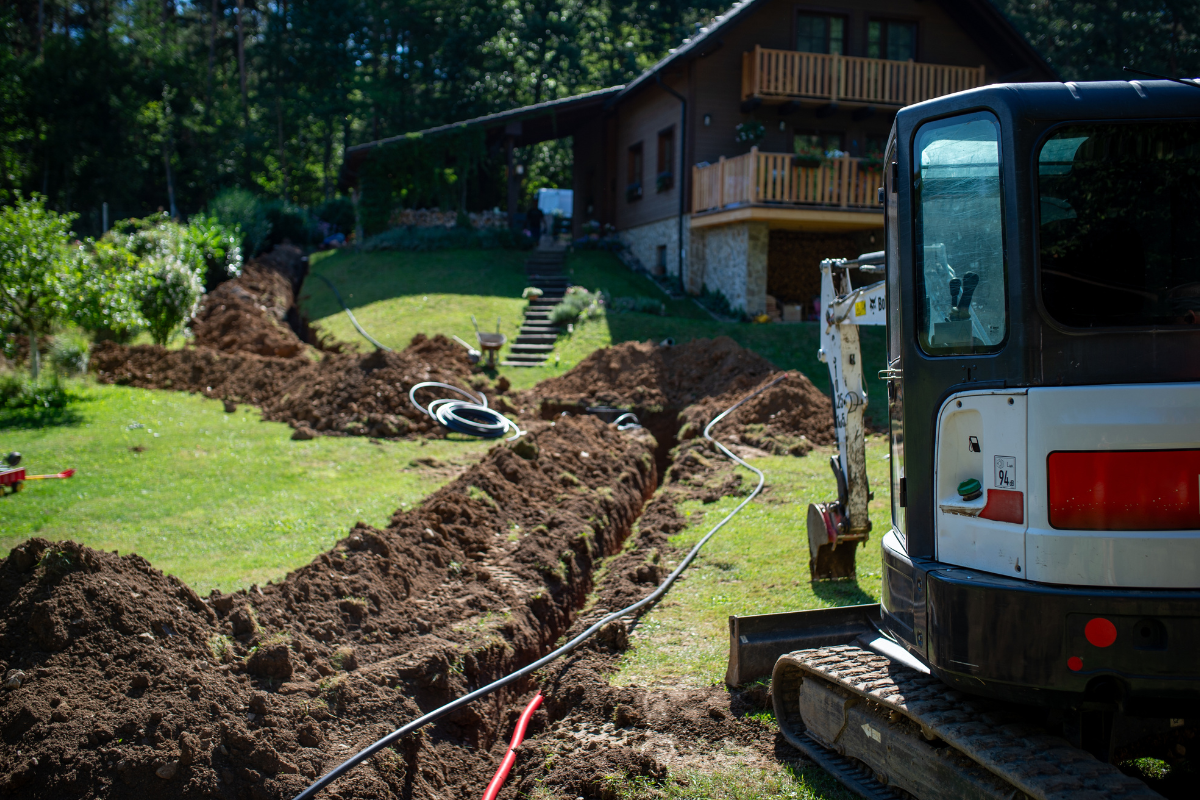
This is where your tradesperson comes in – an earthworker or a plumber, depending on the complexity of the site. The work involves digging a trench from your house to the connection point to the network, laying the pipes with the correct gradient, installing the necessary inspection chambers, and connecting everything up. In mountainous areas, the laying depth is often greater due to frost, and rocky terrain can make the earthworks considerably more complicated. Factor this into your budget.
Decommission the old individual system
If your house was equipped with a septic tank or a mini-treatment plant, it needs to be properly decommissioned. This means emptying the contents, backfilling or removing the tank, and ensuring there is no risk of collapse in the garden. This is not a minor detail: a poorly decommissioned old tank can pose safety and pollution problems for years to come.
Have the connection checked
Once the work is completed, a connection inspection is carried out by the operator. Warning: this inspection has nothing to do with the SPANC (which only concerns non-collective systems). This is a specific inspection for connecting to the public network. It must be carried out before the trench is backfilled, otherwise it will have to be reopened.
Focus Haut-Giffre: In the CCG, a check of the connection to the sewerage system has become mandatory for property sales throughout the intercommunal territory since the resolution of 21 January 2026. If you are selling or buying, this is a point that absolutely must be checked.
How much does drainage cost for a house?
That's the question everyone's asking, and the honest answer is: it depends. But here are some rough estimates to help you get a clearer picture.
Mains drainage
The cost is made up of several items. First, the PFAC (Participation pour le Financement de l'Assainissement Collectif), the connection contribution charged by the local authority. In the Haut-Giffre, the CCG's 2026 PFAC is €20/m² for the first 100 m² of floor area, then €30/m² beyond that. For a 120 m² house, that comes to €2,600.
Next, the private connection works (trenching, pipes, inspection chambers): budget between €2,000 and €6,000 depending on the distance to the network and the nature of the ground. In rocky terrain – common in the Giffre valley – the bill can increase noticeably. Add the connection inspection (a few hundred euros) and the restoration of the land.
Off-mains drainage
The budget is generally higher. A soil study costs between €500 and €1,500. The supply and installation of a complete system (septic tank + treatment system, or compact wastewater treatment plant) cost between €8,000 and €15,000 depending on the system chosen and site constraints. SPANC inspection costs between €100 and €200. Future maintenance must also be factored in: septic tank emptying around every 4 years (€300 to €500 per visit in Haute-Savoie), periodic SPANC inspections.
Why are price differentials important
Several factors can cause the quote to vary from one to three times its initial amount: the distance between the house and the network (or the location of the individual installation), the slope of the ground, the nature of the soil (rock, clay, sand), the accessibility of the site for earthmoving equipment, and the need for a pumping station if the house is below the network level. In mountainous areas, these constraints often accumulate.
Never trust a price range found on a forum. Get a detailed quote from a tradesperson who has visited the site and knows the local constraints.
Selling, buying, renovating: when you need to be vigilant
If you are selling
Since 2011, a drainage inspection has been mandatory when selling a house with off-mains drainage. If the system isn't compliant, the buyer has one year after completion to bring it up to standard. In the CCG area, since January 2026, an inspection of the mains connection has also been mandatory on sale. Get your documents ready to avoid unpleasant surprises at the compromis (preliminary contract) stage.
If you buy
Check the drainage inspection report in your sale file carefully. A non-compliant system can cost €5,000 to €15,000 to bring up to standard. It's a legitimate point for negotiating the price, and it also changes the total budget for your project.
If you are renovating
An extension, a change of use (a barn converted into a home) or simply adding a bathroom can change your drainage needs. A septic tank sized for 3 main rooms is no longer enough if you add two more. Check with the SPANC or the network operator whether your work requires upgrading your system.
Regulations: In the event of a refusal to connect or persistent non-compliance, the municipality may impose financial penalties and, in certain cases, have the work carried out by default at the owner's expense.
How do you choose the right tradesperson for drainage work?
The right criteria
A good drainage contractor in Haute-Savoie is someone who has already worked on similar jobs in your area (the constraints aren't the same in Samoëns as in Annecy), has valid ten-year insurance, understands the requirements of the SPANC or network operator, gives you an itemised quote, and knows how to coordinate their work with the public service for inspections.
In the mountains, local experience counts more than anywhere else. A groundworker accustomed to the rocky terrain of the Giffre will not work at all in the same way as a groundworker from the plains. Flow gradients, laying depth in frost zones, managing rainwater on steep terrain – these are skills acquired on site, not from a catalogue.
Mistakes to avoid
Choosing on price alone. In drainage, a botched job can cost far more to put right than doing it properly first time. Not checking that the quote covers the full scope (some quotes leave out decommissioning the old tank, reinstating the ground or the inspection). And above all, never start work before you have the SPANC's approval or the operator's requirements – otherwise you may have to start again.
On Habitat Corner, we list recommended building tradespeople in the Giffre Valley and Haute-Savoie. If your project involves your home's drainage, you can browse our selection and present your project directly to the tradespeople suited to your village and situation.
In summary
For a drainage project, the right question isn't just “how much does it cost?”. It's first: am I on mains drainage or not? And who should I talk to?
Once this point has been clarified – and a call to the local council or CCG is often enough – the steps will follow logically. The work is technical but well-signposted. And choosing the right tradesperson, someone who knows your local area and its constraints, makes all the difference between a smooth project and an administrative nightmare.
Need a tradesperson for drainage or a mains connection in the Giffre Valley? Browse our selection of recommended tradespeople and tell them about your project.
Find our recommended tradespeople in the Giffre Valley for your drainage work: Plumbers and heating engineers.